

Why Your Website Isn't Generating Leads — And How to Fix It
Why is your website not generating leads? The 7 most common reasons and concrete fixes — self-auditable in 15 minutes.
 // featured
Your website gets visitors. The numbers in Google Analytics are climbing, you share the address on business cards and in emails — but the phone isn't ringing, and not a single enquiry lands in your inbox. It feels frustrating, but it's rarely a traffic problem. It's a conversion problem: people arrive on your site and leave again without taking the next step. The good news is that the causes are almost always the same — and they can be fixed. Here are the seven most common ones, with concrete solutions and a self-audit at the end.
Reason 1 — No clear offer above the fold
Visitors decide within seconds whether to stay or click away. In that time, your homepage has to answer three questions: What do you offer? Who is it for? And why you? If all that sits at the top is a pretty image and a line like "Welcome to our website" or "Your partner for quality", the visitor has understood nothing — and they're gone.
The problem is nearly always interchangeable buzzwords. "Innovative", "experienced", "passionate" tell people exactly what they tell them about every competitor: nothing. Instead, write specifically what you do and for whom. "Tax advice for trade businesses around Manchester" is understood in five seconds. "We shape your future" is not.
Reason 2 — Not enough contact opportunities
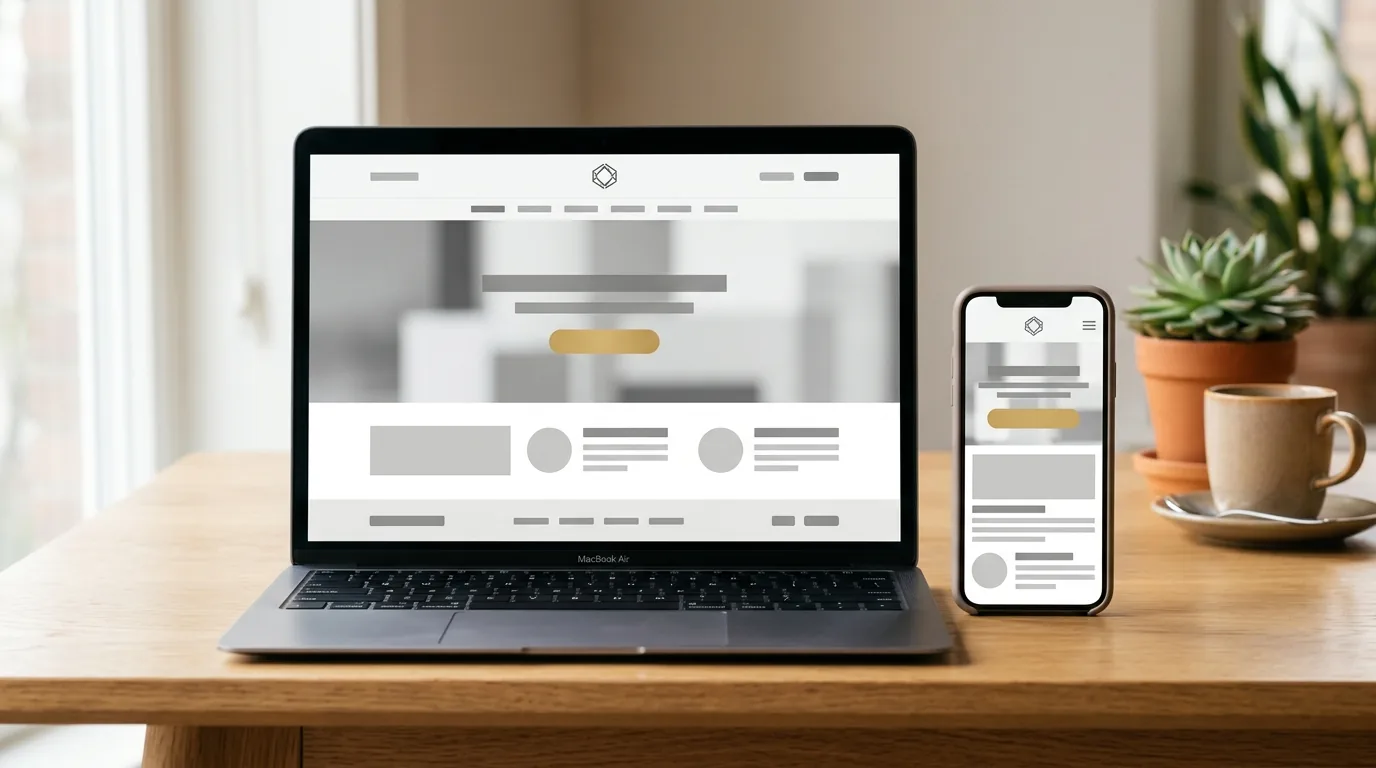 Clean website homepage on a laptop and smartphone with a clear headline and a prominent gold contact button
Even someone who's convinced will bounce if reaching out is too much hassle. A single "Contact" link tucked in the top menu isn't enough. Every page should offer a clear next step — and it should be reachable in one click.
In practice that means: a visible button in the navigation, a call to action at the end of each important section, and your phone number as a clickable link that starts the call directly on a smartphone. Make it as easy as possible for visitors to reach you. Every extra click, every hunt for the contact path, costs you enquiries.
Reason 3 — Slow load time
Speed isn't a technical detail, it's a direct revenue factor. Around 53% of mobile users abandon a page that takes longer than three seconds to load — before they've even seen what you offer. These visitors barely register in your statistics, but they're lost customers all the same.
Test your site for free with Google PageSpeed Insights. If the score sits in the red or orange, this is often the simplest and most powerful lever you have. The most common causes are uncompressed images and too many plugins or tracking scripts. We've covered how to tackle this systematically in a separate post on loading speed.
Reason 4 — No trust signals
Nobody sends an enquiry to a stranger. Trust is built before someone picks up the phone — and that's exactly what good trust signals do. Real photos of you and your team are a hundred times more powerful than anonymous stock images of smiling models everyone has seen a thousand times.
That includes named reviews, visible references or case studies, and specific numbers instead of vague promises. "Over 200 projects delivered" is verifiable and credible. "We're the best" is just a claim. Show that behind the website are real people with real results.
Reason 5 — The contact process is too complex
The most common conversion killer right before the finish line is an overloaded contact form. Ask someone to fill in first name, surname, company, phone, industry and three mandatory fields just to make a simple first enquiry, and they'll give up. For first contact you rarely need more than a name, one way to reach them, and a short message.
Cut it back to the essentials — three fields is often plenty. Drop the off-putting captcha puzzles, and send a short confirmation the moment the form is submitted so the sender knows their message arrived. Every additional field measurably lowers the number of completed forms.
Reason 6 — Not mobile-optimised
More than 60% of all searches now come from a smartphone. If your site on a phone is just a shrunken version of the desktop layout — tiny text, misaligned buttons, images spilling over the edge — you're losing the majority of your visitors without realising it.
A good website today is built from small to large: designed for the phone first, then expanded for bigger screens. Buttons need to be reachable with a thumb, text readable without zooming, the contact path even simpler on mobile than on desktop. Take a quiet moment to check your own site on a phone — you'll be surprised what you notice.
Reason 7 — Speaking to the wrong audience
Sometimes everything works technically and the enquiries still don't come — because the language and imagery don't match the people you actually want to reach. A family-law practice that sounds like a corporate megafirm scares off exactly the individuals who should be its clients.
Speak the language of your real customers. What questions do they ask? What worries do they have? What words do they use themselves? A website that feels like it was written for someone else creates distance without anyone noticing — and distance doesn't lead to an enquiry. Clarity and closeness do.
A 15-minute self-audit
Pull up your website and work through the seven points honestly. Even two or three "no" answers explain why the enquiries aren't coming.
| Checkpoint | Pass? |
|---|---|
| Is it clear within 5 seconds what you offer and for whom? | Yes / No |
| Is there a clear path to get in touch on every page? | Yes / No |
| Does the site load in under 3 seconds (PageSpeed Insights)? | Yes / No |
| Do visitors see real photos, names and reviews? | Yes / No |
| Does the contact form have at most three or four fields? | Yes / No |
| Does the site work flawlessly on a smartphone? | Yes / No |
| Does the language match your actual customers? | Yes / No |
For the test you only need two free tools: Google PageSpeed Insights for speed, and a look at the bounce rate of individual pages in Google Analytics. Wherever an unusually high share of visitors leaves immediately is usually where the problem sits.
If your website has visitors but isn't bringing in customers, the lever is almost never buying even more visitors. It's turning the visitors you already get into enquiries. And that is something you can measure, test and improve — step by step.
We'll tell you honestly what isn't working
In a free website audit we review your site and show you the biggest conversion gaps — concrete, clear, and with no sales pressure.

You might also like

How Much Does It Cost to Have a Website Built? An Honest Breakdown
How much does a website cost? Real price ranges from website builders to custom development — and an honest guide to which option suits your business.
Website Redesign: When You Actually Need One and How to Avoid Losing Rankings
Website redesign: when you need one, what it costs, and how to avoid the most common mistake (losing your Google rankings). A practical guide.

Conversion Rate Optimization: More Customers from the Same Traffic
Conversion rate optimization: more leads without more ad spend. The 5 key levers and how to get started without a big budget.
Read all articles
More posts on web design, SEO and digital marketing for real estate professionals.