

What Makes a Good Website? 7 Qualities That Actually Convert Visitors
What makes a good website? 7 concrete qualities that turn visitors into customers — with a self-audit checklist.
 // featured
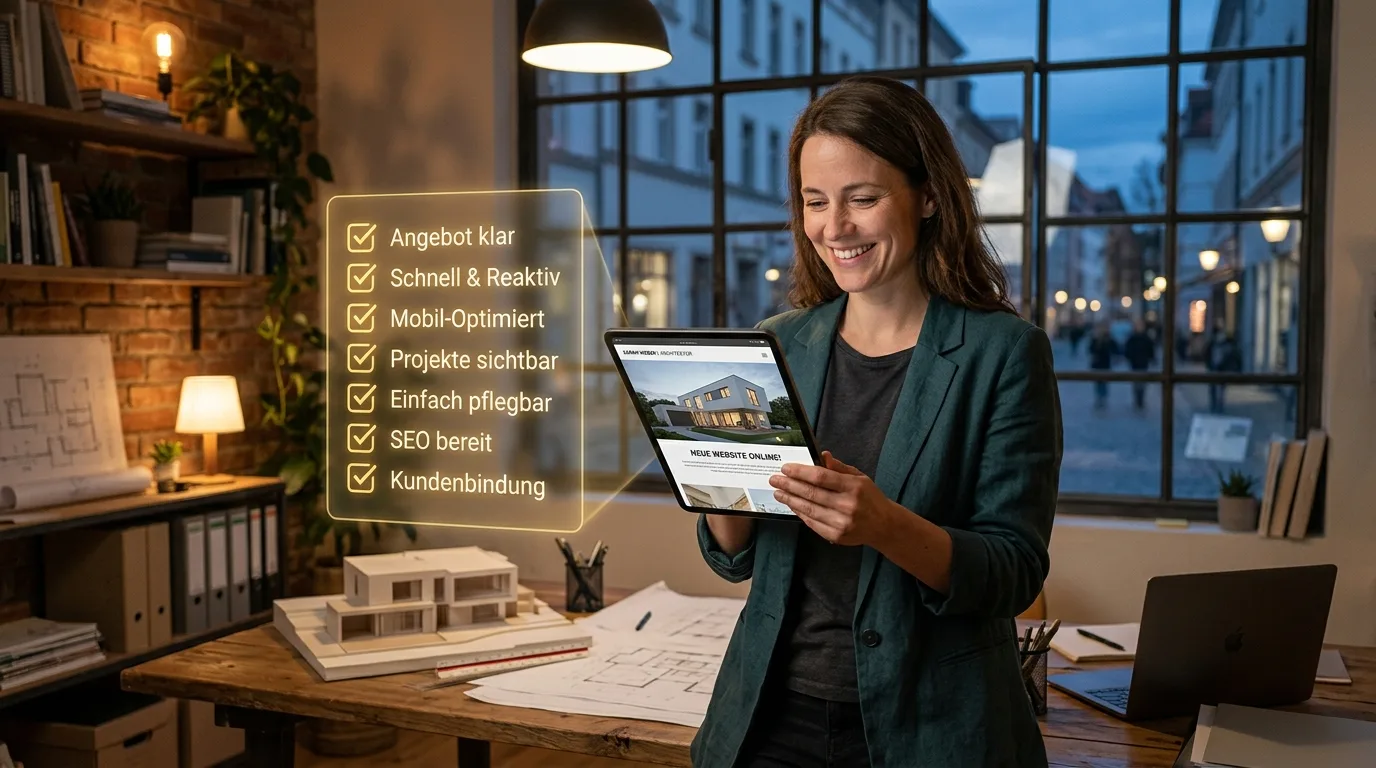
A website that doesn't convert isn't an asset — it's a recurring cost. It costs you hosting, upkeep, and the time you once invested in building it, without ever sending an enquiry back your way. The difference between a website that merely exists and one that actually wins customers is rarely down to a single glaring mistake. It comes down to a handful of concrete qualities that good websites share and mediocre ones don't. This guide walks through them — with a self-audit at the end you can run on your own site in 15 minutes.
Quality 1 — Clear positioning in 5 seconds
Visitors decide within seconds whether to stay. In that time, your homepage has to answer three questions: What do you offer? Who is it for? And why you, specifically? If all that sits at the top is a generic line like "Your partner for innovative solutions", the visitor has learned nothing in those crucial seconds — and they're gone.
What works instead: concrete language over buzzwords. "Tax advice for trade businesses around Manchester" is understood in five seconds. "We shape your future" is not. Good positioning names the audience directly and states the offer in terms of concrete benefit — not self-description.
Quality 2 — Real performance under 2 seconds
Load time is both a ranking factor and a conversion factor — not a technical detail only developers care about. Around 53% of mobile users abandon a page that takes longer than three seconds to load, before they've even seen what you offer. Google also factors load time directly into rankings through the Core Web Vitals.
Test your own site for free with Google PageSpeed Insights. If the score sits in the red or orange, that's often the single most impactful fix available to you — the most common causes are uncompressed images and too many plugins or third-party scripts. We've covered how to tackle this systematically in a dedicated post on loading speed.
Quality 3 — Mobile-first design
More than 60% of all searches now come from a smartphone. A good website is therefore built from small to large — designed for the phone first, then expanded for bigger screens. A desktop layout simply shrunk down, with tiny text and misaligned buttons, is the opposite of that, and it costs you the majority of your visitors without showing up clearly in the numbers.
Buttons need to be reachable with a thumb, text readable without zooming, and the contact path on mobile should be at least as simple as on desktop — arguably simpler, since distractions on the go are greater.
Quality 4 — Low-friction contact paths
 Close-up of a smartphone and laptop side by side showing the same clean website with a clearly visible gold contact button on both screens
Even a convinced visitor will bounce if reaching out is too much hassle. A single "Contact" link buried in the menu isn't enough. Every page should offer a clear next step, reachable in one click: a visible button in the navigation, a call to action at the end of each important section, and your phone number as a clickable link that starts the call directly on a smartphone.
Make it as easy as possible to reach you — every extra click, every hunt for the contact path, measurably costs you enquiries.
Quality 5 — Trust signals that actually work
Nobody sends an enquiry to a stranger. Trust is built before someone picks up the phone. Real photos of you and your team carry far more weight than anonymous stock images of smiling models everyone has already seen a thousand times. Add named reviews, visible references, and specific numbers instead of vague promises.
"Over 200 projects delivered" is verifiable and credible. "We're the best" is just a claim. Show that behind the website are real people with real results — that's the difference between a site that builds trust and one that only claims to be trustworthy.
Quality 6 — SEO baked in from the start, not bolted on later
A good website is structured from day one so Google can understand it — clean HTML, a sensible heading hierarchy, fast load times, meta titles and descriptions that actually describe the content. SEO added as an afterthought via a plugin can rarely fully compensate for structural weaknesses.
That doesn't mean every page needs to be optimised for a keyword. It means the foundation is right: every page has a clear topical focus, internal links connect related content in a way that makes sense, and the technical base doesn't hold the ranking back before the content even gets a chance.
Quality 7 — Full legal compliance
A professional presence doesn't end at the design. A cookie consent banner, a complete legal notice, an up-to-date privacy policy, and a valid SSL certificate aren't optional for businesses — and they double as a trust signal. A missing privacy policy or a browser warning over missing encryption makes even an otherwise convincing offer feel unreliable.
Check in particular whether embedded services like fonts, analytics, or map embeds are configured in a privacy-compliant way — a frequently overlooked point that can turn expensive if flagged.
Self-audit: does your website meet all 7 qualities?
Work through your own website against the seven points below. Even two or three "no" answers often explain why the enquiries aren't coming.
| Quality | Pass? |
|---|---|
| Is it clear within 5 seconds what you offer and for whom? | Yes / No |
| Does the site load in under 2 seconds (PageSpeed Insights)? | Yes / No |
| Does the site work flawlessly on a smartphone? | Yes / No |
| Is the contact path reachable in one click on every page? | Yes / No |
| Do visitors see real photos, names and reviews? | Yes / No |
| Is the technical structure built to be search-engine friendly? | Yes / No |
| Are your legal notice, privacy policy and SSL complete and current? | Yes / No |
You only need two free tools for this test: Google PageSpeed Insights for speed, and a quick look at your own site on a smartphone. Wherever you're unsure whether the answer is really "yes", that's usually the answer.
These seven qualities build on each other: a fast, mobile-optimised site achieves little if the offer isn't clear within 5 seconds. Trust signals don't work if the contact path is too complicated. Only together do they turn a website that merely exists into one that actually works — and turns visitors into customers.
We build websites that meet all 7 qualities
In a free discovery call we'll look at where you stand today and show you exactly what a website that actually wins customers would need to look like for you.

You might also like

Why Your Website Isn't Generating Leads — And How to Fix It
Why is your website not generating leads? The 7 most common reasons and concrete fixes — self-auditable in 15 minutes.

How to Improve Website Loading Speed (And Why It Costs You Customers)
How to improve website loading speed: the 5 most common causes of slow sites and what to do about each — with and without a developer.
How Much Does It Cost to Have a Website Built? An Honest Breakdown
How much does a website cost? Real price ranges from website builders to custom development — and an honest guide to which option suits your business.
Read all articles
More posts on web design, SEO and digital marketing for real estate professionals.