

WordPress vs. Custom-Built Website: Which Is Actually Right for Your Business?
WordPress vs. custom website: an honest comparison of real advantages, real disadvantages, and which option actually suits your business goals.
 // featured
WordPress powers 43% of all websites on the internet. Yet many professional web agencies actively recommend against it for new projects. Both things are true. That contradiction is not a marketing trick — it is a sign that the right answer depends, as it usually does, on the specifics. This article lays both options out honestly: what WordPress genuinely delivers, where it hits its limits, and when a custom-built website is the better call.
What WordPress does well — and who it is actually good for
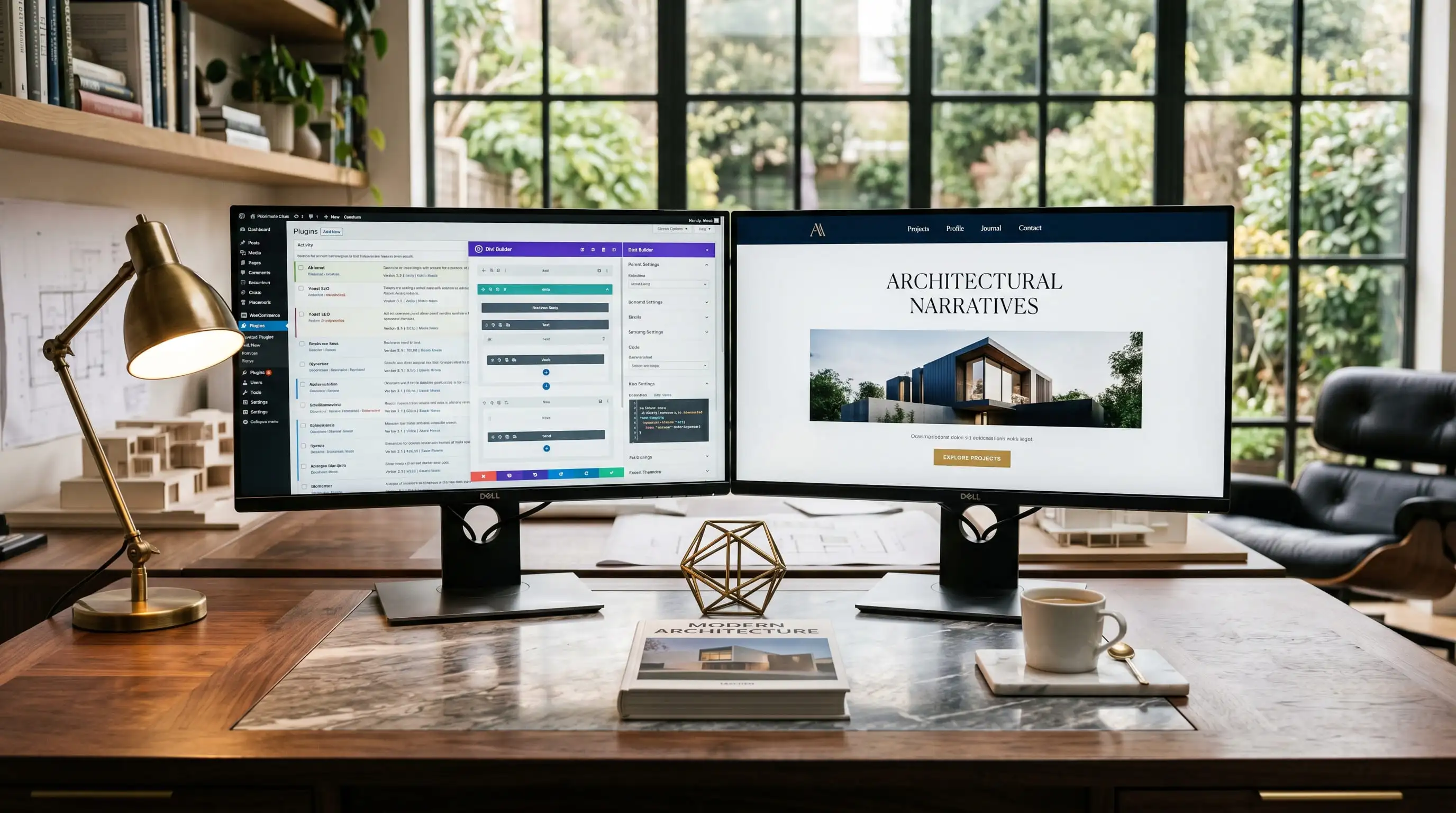
 WordPress dashboard next to the code of a professionally built website
WordPress did not become the world's most widely used website platform by accident. There are real strengths that hold up for certain use cases.
Fast to launch. A WordPress setup with a quality theme can be up and running within days. For businesses that need an online presence quickly and cannot afford a longer development timeline, that is a genuine advantage.
A vast plugin ecosystem. There is a plugin for almost everything: contact forms, booking systems, review widgets, multilingual content, newsletter integrations. That saves development time and makes many standard features accessible on a moderate budget.
Editorially self-manageable. The WordPress backend is usable by editors without programming knowledge. If you publish blog posts, news updates, or product pages regularly and have no technical background, WordPress provides a workable interface.
When WordPress genuinely makes sense: your in-house team will manage content themselves; the budget does not allow for a full custom build; the site is primarily a digital business card with no organic search growth ambitions.
The real disadvantages of WordPress
WordPress's weaknesses rarely come up in sales conversations. They show up in operation — sometimes weeks later, sometimes months.
Plugin-driven performance overhead. Every installed plugin adds code, database queries, and load weight. A WordPress site running 15 to 20 plugins loads structurally slower than a cleanly built custom site — even when both run on identical hosting. Load time is not a technical footnote: Google uses it as a ranking signal, and more than half of visitors leave if a page takes over three seconds.
The most-hacked CMS in the world. WordPress's dominance makes it the preferred attack target. Vulnerabilities in plugins and themes are exploited regularly. Weekly updates are not a recommendation — they are non-negotiable maintenance. A site left unupdated for a few weeks is a site at real risk of compromised content, injected malware, and Google safety flags.
Plugin dependency as a strategic risk. Plugins are built and maintained by third parties. What works today can be discontinued, paywalled, or made incompatible tomorrow. Anyone who relies on plugins for critical functionality is structurally dependent on their continued development. That is not bad programming — it is the foundational nature of an ecosystem that no one centrally controls.
Total cost, consistently underestimated. WordPress itself is free. But professional hosting, premium plugins, annual licences, maintenance retainers, and sporadic developer fees for updates all accumulate. When properly accounted for, the monthly total often lands in similar territory to a custom solution — but with structurally weaker performance and more ongoing overhead.
What a custom-built website delivers
A custom-built website contains only what it needs. No plugin overhead, no unnecessary code, no external update cycles. That sounds abstract, but it has direct consequences for what users and Google experience every day.
Structurally better Core Web Vitals. Google evaluates load time, interactivity, and visual stability under the umbrella of Core Web Vitals. A cleanly built custom site reaches green scores in all three categories almost by default — because there are no unnecessary scripts, no bloated themes, and no plugin stack running in the background. On WordPress, achieving the same results requires ongoing optimisation work that is never fully finished.
No CMS maintenance burden. No database running dozens of plugins means no dozens of potential attack vectors. CMS security updates, theme patches, plugin updates — they simply do not exist. Neither does the quiet, continuous work required to keep a WordPress installation running safely.
Full control over SEO architecture. Technical SEO on a custom site is a design decision, not a configuration task. URL structure, per-page load times, structured data, internal linking architecture — these are built in correctly from the start and stay stable. With WordPress, you are often working against the system rather than with it.
Stable for years. A professionally built website is as fast in three years as it was on day one. No accumulated plugin debt, no legacy workarounds, no backlog of pending updates. That is not a luxury — it is the baseline for a site that functions as a growth channel over time.
Side-by-side comparison
| Criterion | WordPress | Custom-built |
|---|---|---|
| Load time | Depends on plugin count | Structurally fast |
| Maintenance burden | High (weekly updates) | Low |
| Security | Most-targeted CMS | No generic attack surface |
| SEO control | Limited (plugin-dependent) | Full |
| Long-term cost | Often underestimated | Predictable |
| Self-manageable content | Yes (CMS backend) | Limited |
| Time to launch | Fast | Longer |
| Scalability | Medium | High |
No result in this table is absolute. But it shows where the structural differences lie — independently of which agency builds the project.
When WordPress is still the right call
There are situations where WordPress is not just acceptable but the better choice.
If an in-house team needs to publish content independently and regularly, the WordPress editorial backend is a genuine advantage. Custom systems rarely offer a comparable publishing interface without building a bespoke one.
If the budget does not allow for a full custom build, a lean WordPress setup with a small number of deliberately chosen plugins is better than no professional website at all. The difference lies in how it is built: a WordPress site built sparingly performs meaningfully better than one loaded with plugins.
If the site is intended as a short-term solution — with a larger project following in the next 12 to 18 months — WordPress is available quickly and avoids committing planning resources to a permanent build.
When custom wins
SEO is a real growth channel. Organic visibility on Google depends heavily on technical performance. Businesses that want search traffic to drive enquiries need a foundation that loads fast, indexes cleanly, and does not throttle itself through plugin overhead.
The site needs to stay stable for years. If you have no capacity for weekly CMS maintenance and need a site that runs as reliably in three years as it does today, custom is the better bet.
Specific features that no plugin handles cleanly. Complex booking logic, proprietary database connections, custom pricing calculators, or specific API integrations become either too expensive in WordPress — because plugins need heavy customisation — or too risky, because the solution depends on third-party continuity.
The choice between WordPress and a custom build is not a technical preference. It is a strategic question: what does this website need to deliver in three years?
Not sure which fits your situation?
We'll figure it out together in a free 30-minute call — no pressure, no sales pitch, just an honest answer.

You might also like
How Much Does It Cost to Have a Website Built? An Honest Breakdown
How much does a website cost? Real price ranges from website builders to custom development — and an honest guide to which option suits your business.

Why Your Website Isn't Generating Leads — And How to Fix It
Why is your website not generating leads? The 7 most common reasons and concrete fixes — self-auditable in 15 minutes.

How to Improve Website Loading Speed (And Why It Costs You Customers)
How to improve website loading speed: the 5 most common causes of slow sites and what to do about each — with and without a developer.
Read all articles
More posts on web design, SEO and digital marketing for real estate professionals.