

Build Your Own Website or Hire a Web Agency? An Honest Guide
Build your own website or hire an agency? An honest decision guide with a comparison table — no sales copy, just clear criteria.
 // featured
Both routes can be the right choice — it depends entirely on what you need the website to do. This is not a sales pitch for agencies. It's an honest decision guide built around the criteria that actually matter, so you land on the choice that fits your business — not our revenue.
What website builders actually deliver
Website builders like Wix, Squarespace, or Jimdo have genuinely improved over the past few years. The strengths are real: you can have a working site live within a few hours, costs sit around $15–35 a month, and you don't need to write a single line of code. For a pure digital presence — "we exist, here's our phone number" — that's often more than enough.
The limits show up the moment you want more than presence. Builders run on generic templates thousands of other businesses use too. Load times are structurally worse, because a universal system built for every conceivable use case runs in the background, not just your page. And SEO control is limited: you can edit meta tags and headings, but you can't touch the technical foundation — load time, code structure, structured data. If SEO isn't a goal for you, none of that matters. If it is, it's the deciding drawback.
What an agency does differently
An agency doesn't sell "a website" — it solves a business problem: more qualified leads, sharper positioning, a site built around your brand instead of the nearest available template. That shows up in three places.
Design built around positioning, not template selection. A good agency project doesn't start with "which design do you like" — it starts with "what should a first-time visitor understand within five seconds." Design is a means to an end, not the goal itself.
Performance from day one. A custom-built site on a modern framework like Next.js reaches green PageSpeed scores structurally — no post-launch tuning required, because there's no builder overhead running in the background.
SEO baked into the structure, not bolted on. URL architecture, internal linking, structured data, and meta tags are considered from the start, not squeezed afterward into an existing system that was never built for it.
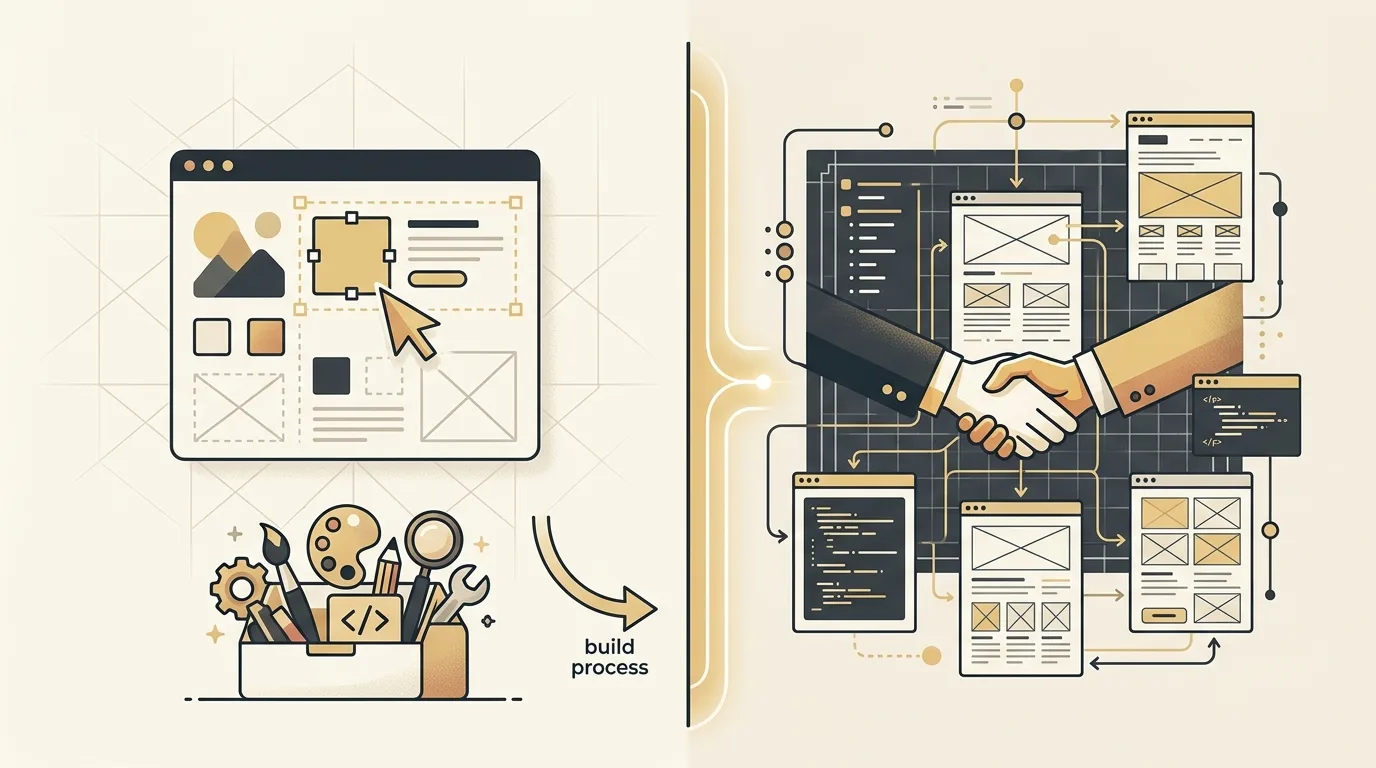 Comparison of two paths to a website: a toolbox with a builder-editor icon on the left, a handshake surrounded by wireframes and code on the right — symbolic image for DIY vs. agency
The hidden time cost of DIY
The price comparison on paper is one-sided: $20 a month versus several thousand dollars upfront. What's missing from that math is your own time — and for most business owners and freelancers, that's the scarcer resource, not the money.
Budget realistically for 10 to 30 hours of learning curve before you're comfortable in the editor, finding the right blocks, and assembling a page that doesn't look like a template. On top of that comes ongoing upkeep: updating content, keeping an eye on plugins or apps, occasionally readjusting the design because the builder changed its system underneath you. That time is missing somewhere else in your business. The opportunity-cost test is simple: what is an hour of your time worth, and what would you earn doing something else with that hour instead of wrestling with a website builder?
Side-by-side comparison: builder vs. agency
| Criterion | Website builder (Wix, Squarespace, etc.) | Agency (custom development) |
|---|---|---|
| Cost | $15–35/month ongoing | $3,000–15,000 one-off, depending on scope |
| Time investment | 10–30 hrs learning curve + ongoing upkeep | Minimal — you provide content, agency builds |
| Quality & design | Template-based, interchangeable | Custom-built around your positioning |
| Performance | Structurally slower (platform overhead) | Structurally fast, green Core Web Vitals |
| SEO control | Limited to meta tags | Full control over structure and code |
| Scalability | Constrained by platform limits | Freely extensible |
| Maintenance | Your own responsibility | Often included in the package |
The questions that decide it
Instead of "which is cheaper" or "which looks better," these are the questions that actually lead to the right decision:
Does the site need to actively generate leads, or is pure presence enough? If the website is meant to become your most important sales channel, every second of load time and every line of SEO structure matters. If it just needs to confirm that you exist, a builder is more than enough.
Do you have the time and appetite for ongoing upkeep? If you'd rather put your time into your core business, ongoing builder maintenance is a hidden cost that a lot of owners underestimate.
Is SEO a growth channel for you? If you want to be found on Google — not just through referrals and existing contacts — the technical SEO control of a custom-built site is hard to replace with a builder.
The honest answer
A website builder is the right choice if your budget is under $1,000, SEO isn't a goal, and the site is meant to be a temporary or purely representational solution. None of that is a compromise — for that use case, it's the sensible decision.
An agency is the right choice if you want the website to generate measurable leads, SEO is a genuine growth channel for your business, and you'd rather focus on running your business than wrestling with the technical side. The higher upfront cost pays for itself the moment the site starts generating enquiries that weren't showing up before.
There's no universally right answer — only the right answer for what you need your website to actually do for your business.
Not sure which fits?
30-minute call, free, no pressure — we'll give you an honest read on whether an agency is even worth it for your situation.

You might also like
How Much Does It Cost to Have a Website Built? An Honest Breakdown
How much does a website cost? Real price ranges from website builders to custom development — and an honest guide to which option suits your business.
WordPress vs. Custom-Built Website: Which Is Actually Right for Your Business?
WordPress vs. custom website: an honest comparison of real advantages, real disadvantages, and which option actually suits your business goals.

What Makes a Good Website? 7 Qualities That Actually Convert Visitors
What makes a good website? 7 concrete qualities that turn visitors into customers — with a self-audit checklist.
Read all articles
More posts on web design, SEO and digital marketing for real estate professionals.