
Local SEO Guide: How to Get Your Business to the Top of Google
Local SEO guide for small businesses: the most important levers for ranking on Google Maps and local search — prioritised by effort and impact.
 // featured
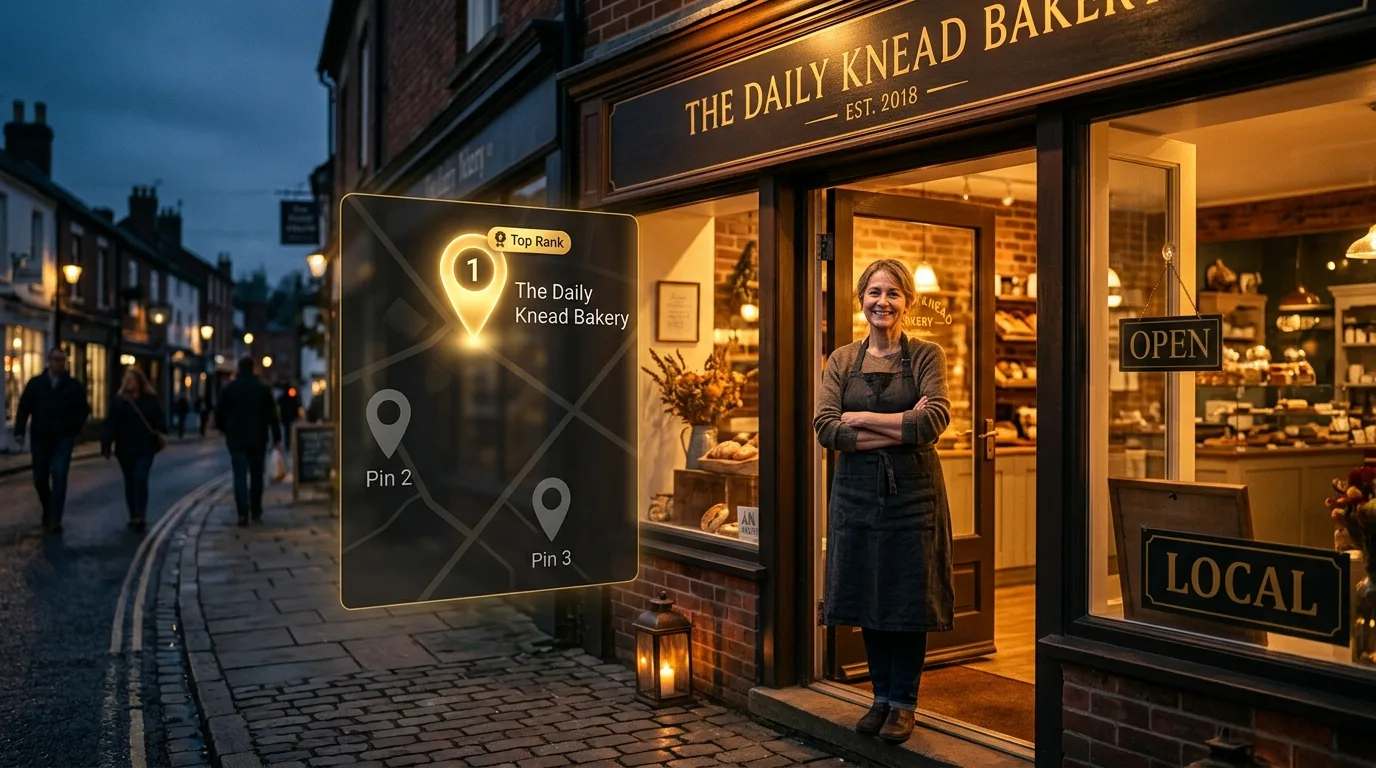
46% of all Google searches carry local intent — "near me", a city name, or implicitly through the searcher's location. If your business doesn't show up for these searches, you're not losing customers eventually, you're losing them every single day, to competitors who are often no better, just better positioned. This guide walks through the most important local SEO levers, prioritised by how fast they work and how much impact they have.
What makes local SEO different from regular SEO
For a local search like "accountant in Manchester", Google doesn't just show the usual ten blue links. Right at the top sits the Local Pack: a map with three highlighted businesses, appearing before the organic results. That box takes the lion's share of the clicks — if you're not in it, you're fighting over what's left.
Google decides who makes the Local Pack based on three pillars:
| Factor | What it means |
|---|---|
| Proximity | How close the business is to the searcher (or the city/area searched for) |
| Relevance | How well the business profile matches the specific search |
| Prominence | How many reviews, mentions, and links speak for the business |
You can barely influence proximity — your location is where it is. Relevance and prominence, on the other hand, can be built deliberately, and that's exactly where local SEO comes in.
The most important lever: your Google Business Profile
No single factor has more influence on local rankings than a complete, actively maintained Google Business Profile. An empty or half-filled profile is the most common reason businesses miss the Local Pack, even when they're genuinely among the best in their city.
The short version: the right primary category, complete contact details, real photos, and above all reviews — one of the strongest local ranking signals there is. In practice, a profile with 40 reviews and a reply to every one of them beats a profile with three reviews and no responses almost every time. We covered the full setup and optimisation process step by step in a dedicated Google Business Profile guide — if there are gaps here, that's the place to start.
Local keywords on your website
Alongside your Google Business Profile, your website itself needs to clearly signal where you operate. The pattern is simple: "[service] in [city]" — for example "dentist in Manchester" instead of just "dentist". Google ties these phrases to local search intent and ranks the page accordingly.
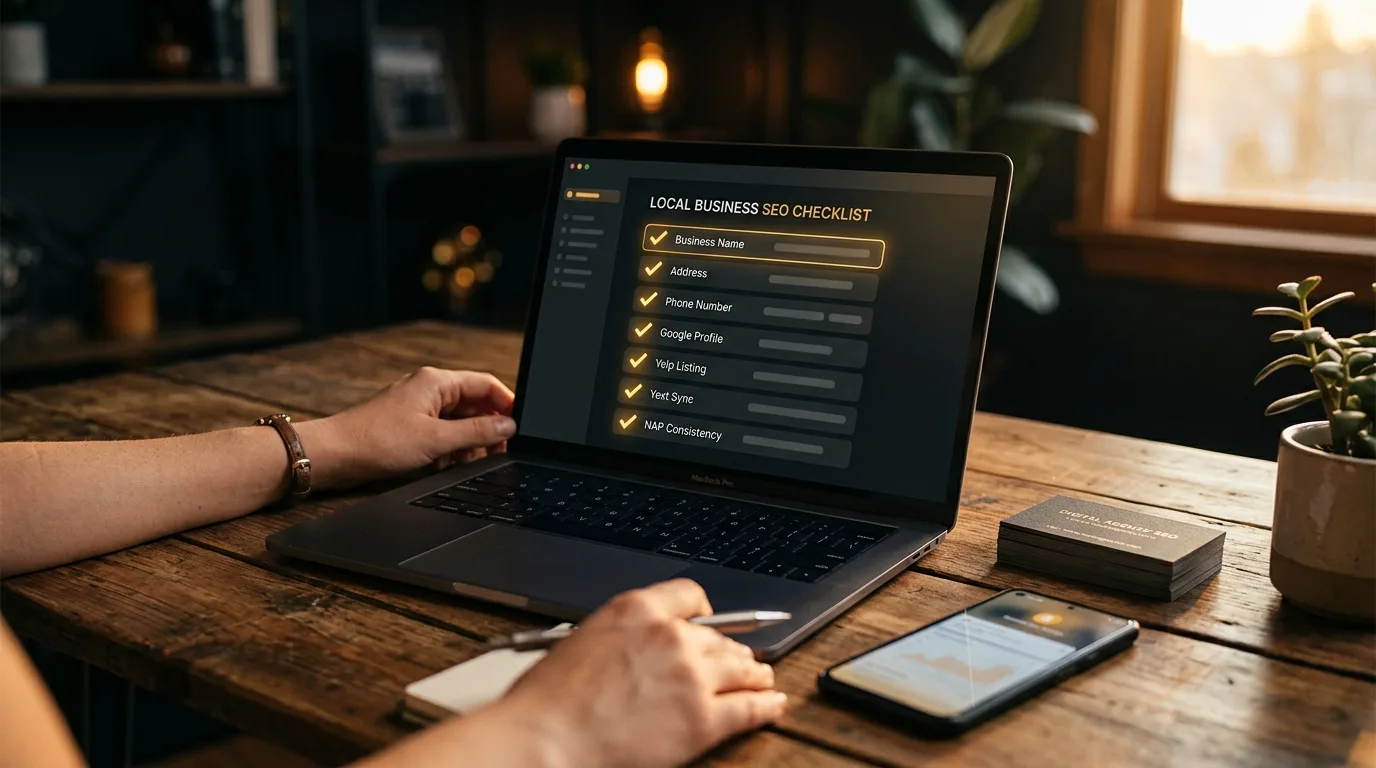 Laptop screen showing a local SEO checklist with gold checkmarks for business name, address, phone number, and directory listings
What matters is where these terms sit: in the page heading, the opening paragraph, the meta title, and the meta description — not artificially crammed into every sentence, but placed naturally where they belong. If you operate in multiple cities or districts, dedicated landing pages per location outperform trying to cram everything onto one page. Each location page can then win on location-specific content, testimonials, and reviews instead of competing with your own other locations for the same rankings.
NAP consistency and local directories
NAP stands for Name, Address, Phone — your three most important contact details. The principle: this data must be exactly identical everywhere online, down to the formatting. "12 Main Street" in one place and "12 Main St." in another is the same address to a human, but to Google it's an inconsistency that costs trust.
List yourself consistently in the directories that matter: Yelp, Bing Places, plus industry-specific portals relevant to your field. Every clean, matching listing is a small additional signal to Google that your business is real, active, and trustworthy.
Building local backlinks
Prominence — the third pillar above — also comes from links from other websites, and local backlinks are particularly powerful here because they reinforce the geographic connection at the same time. Unlike general link building, the goal isn't as many links as possible, but a handful that are genuinely relevant, both topically and geographically:
- Local press — a mention or interview with the regional paper earns a strong, credible link
- Partners and collaborations — mutual links with businesses you already work with
- Trade associations and chambers of commerce — membership almost always comes with a listing and a link
- Sponsorships — local clubs, community events, and sports teams often link back to their sponsors
A single link from your local council or chamber of commerce is often worth more than ten generic directory listings, because it carries relevance and trust at the same time.
How long until local SEO shows results
Realistically, expect three to six months before you see noticeable ranking improvements — local SEO isn't a switch you flip, it's a process that compounds. That said, some levers work considerably faster than others:
Fast-acting: A fully optimised Google Business Profile can show visible improvement within a few weeks, especially if key details were missing before.
Takes time: Collecting reviews, building backlinks, and growing a website's overall prominence — these factors compound and take months, not days.
Businesses that work all four levers consistently — Google Business Profile, local keywords, NAP consistency, local backlinks — build a lead that's hard to close. While competitors make sporadic tweaks to their profile, consistent upkeep creates a steadily widening gap in the Local Pack — exactly where most purchase-ready local searches end up.
Free local visibility audit
We check where you stand today and show you the fastest path to the top — no obligation, no sales pressure.

You might also like

How to Set Up and Optimise Your Google Business Profile (Complete Guide)
How to optimise your Google Business Profile: a step-by-step guide for local businesses to rank higher on Google Maps and get more enquiries.

Why Your Website Isn't Generating Leads — And How to Fix It
Why is your website not generating leads? The 7 most common reasons and concrete fixes — self-auditable in 15 minutes.

How Much Does It Cost to Have a Website Built? An Honest Breakdown
How much does a website cost? Real price ranges from website builders to custom development — and an honest guide to which option suits your business.
Read all articles
More posts on web design, SEO and digital marketing for real estate professionals.